Quick Facts
| Spouses | (1) Maria Eve, (2) Mary Brown |
| Dates | 12 December 1792 – 25 October 1870 |
| Son-in-law of | Oswell Eve and Aphra Ann Pritchard |
| Occupation | Merchant, city council, various boards |
Biography
John Bones was the first child of James and Mary (Adams) Bones. He was born at his grandfather’s house, Chequer Hall, in County Antrim, Ireland (now Northern Ireland). His father was a United Irishman who participated in the unsuccessful 1798 rebellion from British rule. His father was also a linen bleacher. The family lived in Ballygarvey and then Ballyportery before immigrating to South Carolina in 1810.
John apprenticed at his uncle’s shop in Augusta, Georgia, and by 1818 became the sole owner the business. Over the years, he partnered with brothers, brothers-in-law, and nephews, helping them to establish themselves.
On 8 April 1818 he married his first wife, Maria “Barney” FitzSimons Eve, the ninth child of Oswell and Aphra Ann Eve, at the Eve home, Forrest Hall. Her cousin Mary Roma Eve married James C. Campbell the same day and place. It was reported that in “former times it was said that Eve was converted out of a bone, but the Rev. Mr. Joice has found a method of reconverting Eve into Bones.”
After 1825, John purchased Cedar Grove, a house in Edgefield, South Carolina. In the summer of 1829, John’s parents and youngest sister moved in. They spent the rest of their respective lives there.
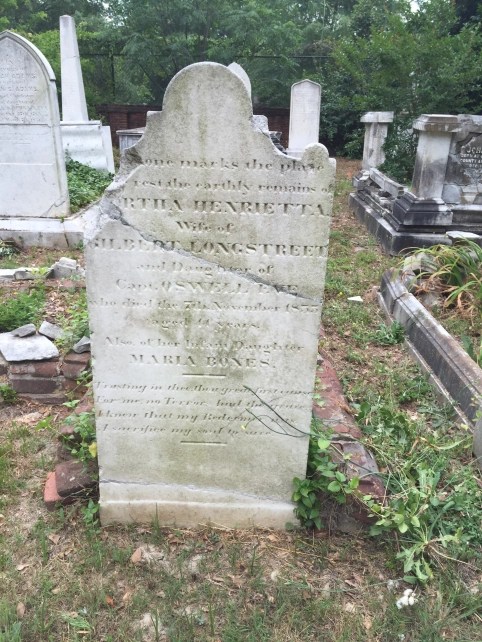
When Maria’s sister, Henrietta (Eve) Longstreet, moved to the country for her husband’s work, John and Maria kept Henrietta’s daughter, Hannah, in Augusta so she could continue her schooling. Hannah stayed on with John following the deaths of Henrietta and Maria.
Maria became ill in the spring of 1833. By June, she had become so weak, she required assistance to stand. John wrote his mother a month before Maria’s death: “I thought when in health that I appreciated her…but I now find that much as I love her I was never fully aware of the…treasure I possess in her, until the prospect of her removal, shews how much I shall lose.” Maria died 3 July 1833.
The following year John, on business in England and Ireland, took time to visit his relatives in County Antrim. His uncle said the visit “surpassed a thousand letters” since so many questions could be asked and answered. While he told his brother nothing could delay his return home, he did bring home something unexpected – a new wife. John married his first cousin, Mary Brown, in Garvagh, County Antrim, Ireland on 25 September 1834. They arrived in Charleston, South Carolina, 10 November 1834, and made their way to Augusta.
John and Mary lived a happy life together. In addition to his business in town, the couple had a house in the Sand Hills area for the summers and other times.
John’s love for his native country never dimmed. He often went to Charleston to celebrate St. Patrick’s Day with the Hibernian Society, making toasts to his homeland. John and Mary returned to Ireland every few years for business and to visit family, sometimes taking nieces with them. He wrote frequently to family, friends, and business associates in Ireland and he helped raised money to help Ireland during the famine years.
John also took an active interest in his community in Augusta. He was elected a city councilman several times. He served on many boards of directors, including the Bank of Augusta, a library society, a free school society, and several for businesses and the Georgia Railroad. John came up with the idea of a cotton factory in Augusta which led to the building of the canal. He was a member of First Presbyterian Church in Augusta. He made reconciliation between George McDuffie, a prominent South Carolina politician, and Colonel William Cumming possible.
Mary died of brain fever in 1865 and John’s health declined until his death on 25 October 1870. He left provisions for his niece Hannah Bones Longstreet, the children of Mary’s brother, children of his deceased brothers, and his three sisters. He left Cedar Grove to his sister, Martha, who lived there from 1829.
After his death, John was described as
liberal, generous and benevolent, always encouraging the young, with always an excuse for the errors of others, his hand never lifted, except in friendly approval, to caress or to best to good upon all whom he could. He was, too, the practical peacemaker, always endeavoring, by his counsel and example, to prevent feuds and ill feeling, and to settle difficulties between his friends….leaving…a large circle of friends and relatives to deplore his loss as that of a good man, kind friend and true Christian.
 Augusta's Historic Cottage Cemetery